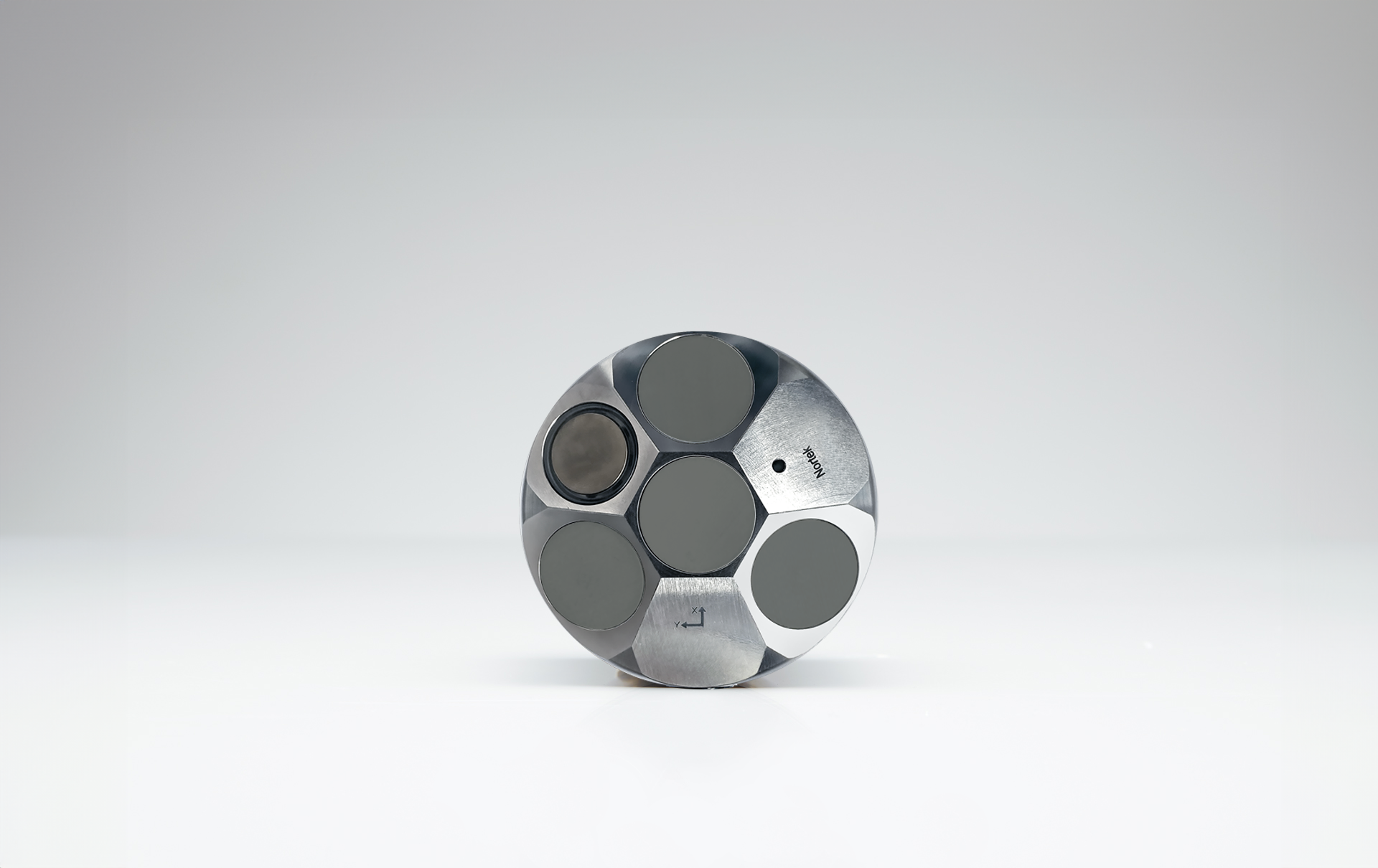
Nucleus 1000: Firmware Update 5.0.0
The latest firmware update for the Nucleus 1000 introduces a series of improvements designed to make underwater vehicle integration easier and improves navigation capabilities.
Among the key updates are direct GNSS integration with the Nucleus INS, improved bottom track performance for AUVs, altimeter enhancements and expanded current-profiling functionality. Together, these updates give vehicle manufacturers and operators new capabilities across navigation, environmental survey and operational applications.
More seamless GNSS integration
The firmware update offers direct support for NMEA0183 GNSS input into the Nucleus INS filters. Previously, updating the vehicle's position from GNSS required a command-based position reset. With the new firmware, position fixes can instead be incorporated automatically into the INS solution when GNSS becomes available, for example when an AUV returns to the surface.
Because the GNSS measurement is fed directly into the navigation filter rather than simply forcing the system to a new position, Nucleus can incorporate the new information while maintaining the vehicle's historical trajectory. For integrators, it also reduces the need to develop additional commands or logic to manage these position updates.
The implementation also supports lever-arm offsets between Nucleus and the GNSS antenna, helping simplify integration on different vehicle configurations.
Improved Bottom Track acquisition for AUVs
The firmware also introduces “NORMAL” bottom track mode as the default, particularly benefiting AUV operations. Acoustic returns from features in the water column, including strong thermoclines, haloclines or concentrations of biological material, can potentially resemble a bottom return. NORMAL mode uses an acquisition period to build confidence before reporting a valid Bottom Track detection.
For an autonomous vehicle, this provides a more robust way of establishing bottom track as it travels through the water column toward the seabed.
Improved altimeter performance
Altimeter performance has also been improved, particularly around unreliable detections at longer ranges. An adaptive noise floor has been introduced to help the system distinguish genuine returns from background noise, reducing false detections in the far field.
The change is an iterative improvement rather than a universal solution for every acoustic environment, but it is designed to provide more reliable altitude measurements for applications depending on this information for dive control and terrain following.
Expanded current-profiling capabilities
The Nucleus 1000 can now output earth-referenced, bin-mapped current profiles, with compatibility for post-processing and visualization in Nortek VM Review software package. This creates additional possibilities for AUV-based environmental surveys as well as ROV operations where information about surrounding currents can support tasks such as tether management and safe recovery.
For applications requiring real-time current information, Nucleus 1000 can provide the current-profile data output for visualization through compatible third-party software.
Greater flexibility in challenging acoustic environments
A new narrow-band mode enables users to choose between bandwidths of 25% or 6.25%. This provides another configuration option for applications where acoustic or electrical noise sources are close to the operating band.
Continuing to develop Nucleus for vehicle integration
From more seamless GNSS integration to more robust Bottom Track acquisition, improved altimeter performance and expanded current profiling, firmware V5.0.0 adds to the Nucleus 1000’s already broad range of functionality, enabling small vehicle operators to achieve even more with this combined navigation solution.
Visit the Nucleus 1000 page to find out what’s new and get more information.


